
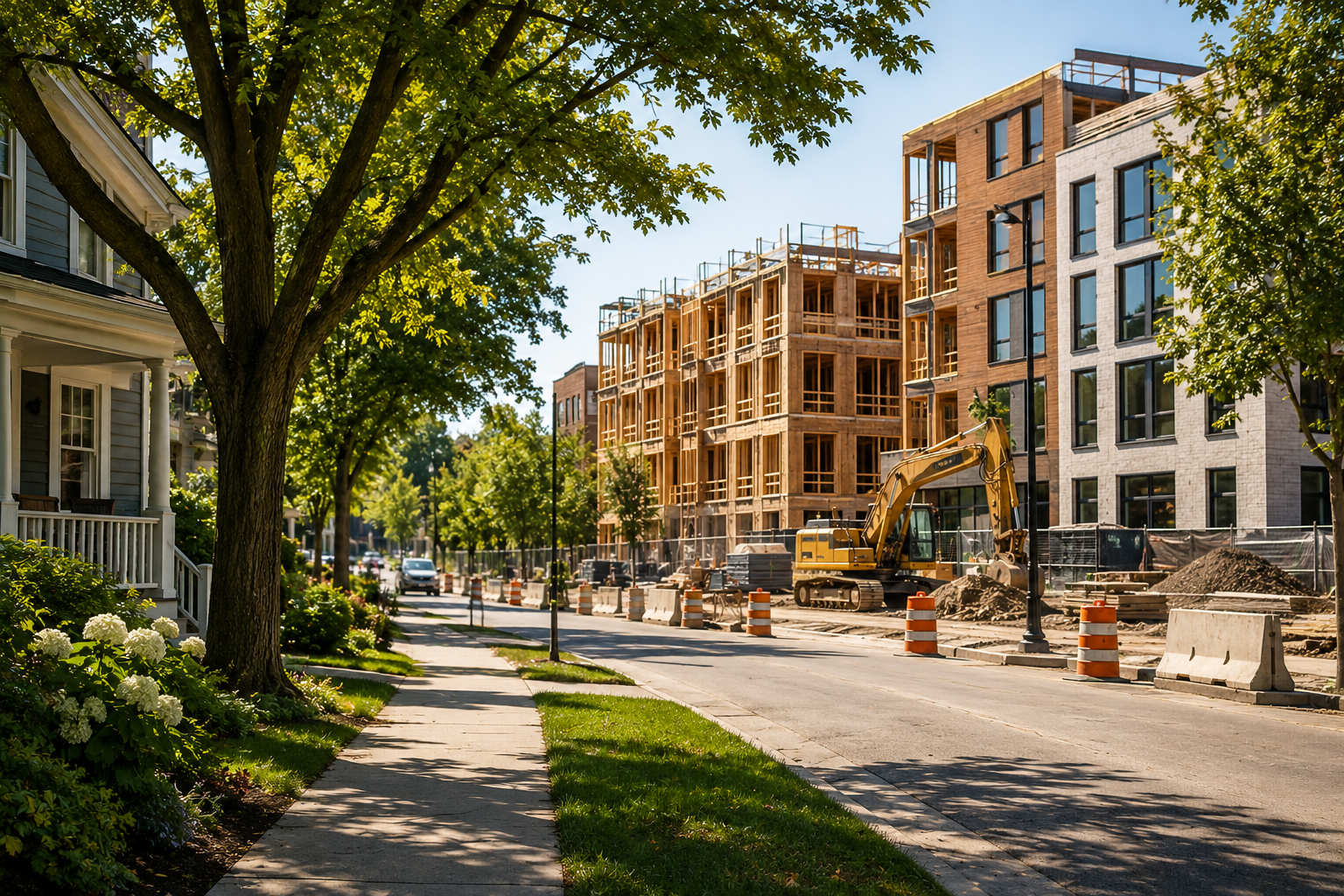
If you've been out looking at homes in Ann Arbor lately, you've noticed something.
Construction is everywhere.
Road improvements, new housing developments, utility projects, transportation upgrades, new commercial spaces... the city is busy. The City of Ann Arbor has called 2026 one of its most active construction seasons in recent memory, with projects running through spring, summer, and fall across the city.
And here's the thing: it's not slowing down anytime soon.
Ann Arbor recently updated its Comprehensive Plan with a clear direction toward higher density zoning, especially near transit corridors and commercial areas. That means more neighborhoods across the city are going to see new development in the coming years, not just the ones already under construction. If you're buying in Ann Arbor, understanding what's planned for a neighborhood is no longer optional. It's essential.
So the question for buyers right now is a fair one:
Should you avoid buying near a construction project?
Not necessarily. But you do need to know what you're actually buying into.
Construction Doesn't Always Mean Trouble
It's easy to see orange barrels, closed lanes, and heavy equipment and immediately think, "Maybe I should look somewhere else."
But construction comes in a lot of different forms.
Some projects are straightforward infrastructure work, resurfacing roads, replacing aging water lines, updating stormwater systems. Others involve new housing, improved sidewalks, bike paths, or redevelopment of properties that have sat underused for years.
Ann Arbor currently has active projects on South Fifth Avenue, Ann Arbor-Saline Road, West Liberty Street, East Stadium Boulevard, South State Street, and plenty of other areas. And with the city's updated zoning pushing toward more density in targeted areas, the pipeline of new development isn't shrinking.
The question isn't simply whether there's construction nearby. The better question is: what's being built, why is it being built, and what does that mean for the neighborhood you're considering?
That's exactly where a great real estate agent earns their keep. Not just by finding you listings, but by doing the research most buyers don't know they need. A good agent is already familiar with the city's project database, knows how to read a zoning map, and can tell you whether that vacant lot next to the house you love is slated to become a park, a parking structure, or a 12-story apartment building. That's not a nice-to-have. That's the difference between buying a home you love in five years and one you're trying to get out of.
The Short-Term Reality
Let's be honest about what living near active construction actually looks like.
You may deal with:
- Increased traffic and detours
- Temporary road or sidewalk closures
- Construction noise during work hours
- Dust, debris, and changes to parking
- Temporary rerouting for pedestrians and cyclists
The City of Ann Arbor has acknowledged that 2026 will bring lane reductions, shifting traffic patterns, and temporary rerouting throughout the season.
For some buyers, that's a dealbreaker. Totally valid.
For others, it's just something to plan around for a year or two.
The key is understanding how long the disruption is expected to last, and whether what gets built is actually going to improve the area for you personally.
Look Past the Construction Fence
One of the biggest mistakes buyers make is judging a neighborhood based only on what they see the day they tour a house.
You walk in, you see a busy road project out the front window, and the whole visit feels off.
But zoom out a little. That project might include improved sidewalks, updated drainage, better crossings, or a completely resurfaced road that will be smoother and quieter than anything in the neighborhood right now.
Ann Arbor's current projects are designed to address transportation, safety, mobility, water infrastructure, stormwater systems, and road conditions that have been aging out for years. Construction can be the messy middle between the neighborhood that exists today and a noticeably better one.
This is where the right agent makes a real difference. Not every agent is going to pull up the city's construction project database before a showing. Not every agent is going to flag that the "quiet road" in front of a listing is scheduled for 18 months of work starting next spring. The right one will. A buyer's agent who knows Ann Arbor well isn't just opening doors, they're showing you the full picture before you decide whether you want to walk through one.
The Ann Arbor Corridors Buyers Should Be Watching
With Ann Arbor's updated Comprehensive Plan actively encouraging higher density development, some corridors are seeing far more activity than others. If you're shopping in or near these areas, pay attention.
South State Street Corridor South State has been a focus area for mixed-use and higher-density development for years, and that's accelerating. With proximity to U of M and major employment centers, expect continued residential and commercial development along this stretch.
Plymouth Road Plymouth Road has long been identified as a priority corridor for reinvestment. The city's planning goals here include increased density, improved pedestrian infrastructure, and better transit connections. Properties near Plymouth Road are likely to see significant change over the next decade.
East and West Stadium Boulevard Stadium Boulevard has active projects underway now and is part of broader plans to improve safety and mobility across the corridor. New housing development in adjacent neighborhoods is following the infrastructure investment.
Near Downtown and the Blake Transit Center The area around downtown Ann Arbor and the Blake Transit Center is a declared priority for transit-oriented development under the city's updated plan. Expect more projects like 350 South Fifth Avenue, which combines affordable housing, commercial space, and direct transit access. If you're buying near downtown, the neighborhood is going to keep densifying.
Ann Arbor-Saline Road and South Side Corridors The south side of Ann Arbor, including areas around Ann Arbor-Saline Road and Pittsfield Township adjacent corridors, is seeing increased development interest as land costs push buyers and developers further from the core. Active utility and road projects are laying the groundwork for more residential growth in this area.
This doesn't mean any of these corridors are bad places to buy. In many cases, it means the opposite. But you need to know what's coming before you commit.
New Development Can Bring New Energy
Not all construction is about roads.
New residential and mixed-use development changes how a neighborhood feels and functions. More housing means more neighbors, new businesses, improved streetscapes, and greater walkability. The 350 South Fifth Avenue project, a planned 20-story mixed-use building with 330 affordable apartments and ground-floor commercial space near the Blake Transit Center, is a good example of the kind of development Ann Arbor is actively pursuing.
And with the city's updated Comprehensive Plan now supporting higher density zoning across more of Ann Arbor, this type of development is becoming more common in neighborhoods that have historically been low-density. That's a significant shift. Areas that felt quiet five years ago are now on a clear path toward more housing, more amenities, and more activity.
That's not inherently a bad thing. But it is something buyers need to understand before they fall in love with a neighborhood's current character without realizing it may look quite different in ten years.
This is exactly the kind of context a great agent should be bringing to every buyer consultation. Not to scare you off, but to make sure you're making an informed decision that aligns with where you actually want to live long-term.
Could Construction Create an Opportunity?
Sometimes, genuinely, yes.
A property located near an actively developing area may get less buyer attention simply because people don't want to deal with temporary inconvenience. That can quietly create an opening for a buyer who's willing to look past current conditions.
This isn't a reason to buy a home near construction just because construction is happening. But if a project is bringing things you already care about, better transportation, more walkability, updated infrastructure, new neighborhood amenities, it's worth thinking about whether that inconvenience is actually worth something.
Ask yourself:
- Will improved transportation make your commute easier?
- Will new sidewalks make the neighborhood more walkable for your family?
- Could new businesses make daily life more convenient?
- Is this project replacing aging infrastructure that would have been someone's problem eventually?
- Could more housing bring the kind of activity and services that make a neighborhood feel alive?
What This Means for Your Resale Value
If you're buying a home, you're probably not thinking about selling it yet. But resale value is always worth thinking about, especially in a market that's actively reshaping itself the way Ann Arbor's is.
Here's the reality: buying near construction can work in your favor at resale, but only if you understand what you're buying into.
Completed infrastructure improvements tend to help. When the road gets resurfaced, the sidewalks get rebuilt, and the utilities get updated, those improvements benefit every property on the block. Buyers touring your home in five years won't see a construction zone. They'll see a well-maintained street with newer infrastructure, and that matters.
Being early in a growing corridor can create significant upside. Properties near developing corridors, particularly ones with transit access, mixed-use investment, or city-designated density zones, have historically seen strong appreciation as those areas mature. If you buy on the front end of that shift, you benefit from the trajectory. If you wait until the neighborhood is fully built out, you pay for it.
High-density zoning nearby is a double-edged sword. Ann Arbor's updated Comprehensive Plan is adding density in a lot of places. That can mean more activity, more amenities, and stronger long-term demand near your property. It can also mean the single-family neighborhood feel you're paying for today may not be what a future buyer sees. Understand the zoning picture before you buy, and price that context into your decision.
The neighborhood trajectory matters more than the current snapshot. Buyers at resale aren't just buying a house. They're buying into a neighborhood story. Is the area improving? Is investment going in? Are amenities getting better? A home in a neighborhood with clear upward momentum is easier to sell, and usually at a better price, than one in an area that's static or declining. Construction, when it's the right kind, is often a signal of that momentum.
A great agent can help you read that trajectory before you buy, not just after you're trying to sell.
Do Your Homework Before Making an Offer
If you're considering a home near a construction project, don't rely on what you can see from the driveway during a showing.
This is exactly what a great buyer's agent should be doing for you before you ever make an offer. Not just pointing to a listing and saying "nice kitchen." They should be pulling up the city's project database, checking the timeline on nearby construction, identifying what's permitted on vacant parcels within a few blocks, and flagging anything in the pipeline that could affect your daily life or your long-term property value.
Ann Arbor's updated Comprehensive Plan has opened up higher-density zoning across more of the city, which means the rules about what can be built near your potential home may have already changed. Your agent should know that. They should be asking: what's already allowed on that empty lot two streets over? Is that commercial corner about to get redeveloped? Is this neighborhood inside one of the city's targeted growth areas? These aren't obscure questions. They're the questions that protect your investment and your quality of life.
A great agent doesn't just help you find a home. They help you understand what you're actually buying into, and what the street, the block, and the neighborhood are going to look like on the other side of all this construction.
So, Dealbreaker or Hidden Opportunity?
It depends on the project. And honestly, it depends on you.
If you work from home and need quiet, living next to an active construction site probably isn't going to work. If parking changes and traffic detours stress you out, you may want to steer clear.
But if you're willing to sit with some temporary inconvenience in exchange for being in a neighborhood that's actively growing and improving, construction may actually be worth a closer look.
Ann Arbor is evolving fast. Roads are being improved, infrastructure is being updated, new housing is going up, and the city's updated Comprehensive Plan is deliberately pushing more of that growth into more neighborhoods. The home you see today may not look the same from the sidewalk in five years.
Sometimes, that's exactly the point.
Thinking About Buying in Ann Arbor?
Finding the right home isn't just about what a property looks like during a showing. It's about understanding the neighborhood, what's being planned around it, and whether the direction it's heading aligns with what you actually want.

At NestEgg Properties, we go beyond the listing. We look at what's coming, not just what's there today. If you're exploring homes in Ann Arbor and want a real read on the neighborhoods you're considering, we'd love to help you get a clearer picture.
Reach out to NestEgg Properties and let's find the place that fits where you're going, not just where you're starting.
Check out this article next